Mumbai tech enthusiasts, the India AI Impact Summit 2026 in New Delhi (held February 19, 2026) delivered blockbuster keynotes from AI heavyweights Sam Altman (OpenAI), Sundar Pichai (Google/Alphabet), and Dario Amodei (Anthropic). They painted a picture of AI at a “civilisational inflection point” — with superintelligence potentially arriving in just a couple of years, massive benefits for humanity (especially emerging economies like India), but serious risks around misuse, economic disruption, and the need for responsible, democratized development.
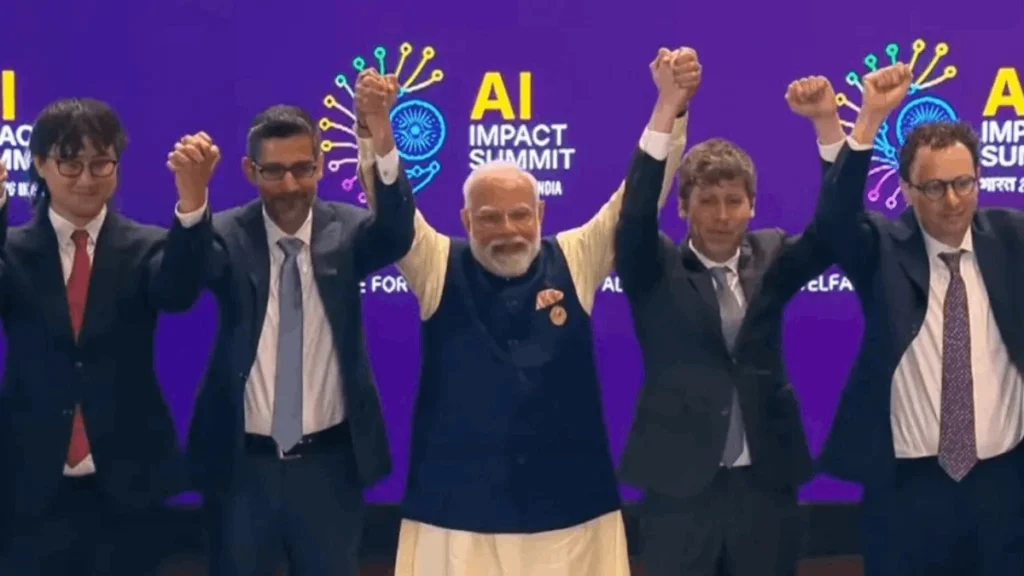
The summit, inaugurated by PM Narendra Modi, focused on ethical AI, global governance, multilingual/inclusive systems, and bridging the potential “AI divide.” While a viral awkward moment (Altman and Amodei avoiding hand-holding in a group photo with Modi) stole some headlines, the real substance came from their warnings and optimistic visions on superintelligence timelines, safety, and equitable access.
Superintelligence Timelines: “Only a Couple of Years Away”
Sam Altman dropped the boldest prediction: Early versions of true superintelligence (AI surpassing top human executives/scientists) could emerge in just a couple of years.
- Altman on Progress & Timeline: “We’ve gone from AI systems that struggled with high school-level math to systems that can do research-level mathematics now and derive novel results in theoretical physics… On our current trajectory, we believe we may be only a couple of years away from early versions of true superintelligence.”
- He added: A superintelligence could outperform any CEO or top scientist — an “extraordinary statement” that demands serious thought.
Dario Amodei echoed the rapid pace: “There are only a small number of years left for AI models surpassing the cognitive capabilities of most humans for most things.”
Both stressed exponential progress akin to Moore’s Law for intelligence.
AI Benefits & Transformative Potential
Speakers highlighted AI’s power to solve humanity’s biggest challenges:
- Amodei: “We have the potential to cure diseases that have been incurable for thousands of years, to radically improve human health, and to lift billions out of poverty, including the global South, and create a better world for everyone.”
- Pichai: “We are on the cusp of hyperprogress and new discoveries that can help emerging economies leapfrog legacy gaps… We have the opportunity to improve lives at a once-in-generation scale.”
Pichai emphasized India’s role in pushing AI frontiers and leapfrogging gaps.
Risks, Responsibility & Safety Concerns
No one shied away from downsides:
- Amodei: “I’m concerned about the autonomous behaviour of AI models, their potential for misuse by individuals and governments, and their potential for economic displacement.”
- Altman: Warned centralization in one company/country could lead to “ruin.” Pushed for democratization as the “only fair and safe path forward” to ensure liberty, democracy, widespread flourishing, and increased human agency.
- He suggested something like the IAEA (International Atomic Energy Agency) for governing superintelligence.
Pichai focused on equity: “Technology brings incredible benefits, but we must ensure everyone has access to them. We cannot allow the digital divide to become an AI divide. That means investing in compute infrastructure and connectivity.”
All agreed: The world is at a crucial moment — benefits could be immense, but risks (misuse, autonomy, displacement) require urgent responsibility, safety measures, and global coordination.
Why This Matters for India & Mumbai in 2026
Altman noted India as OpenAI’s second-largest market, praising rapid progress. Pichai expressed confidence in India’s ability to lead. With the summit pushing inclusive, multilingual AI and infrastructure investment, it positions India as a key player in shaping responsible superintelligence.
The event also featured other leaders (Demis Hassabis, Yann LeCun, etc.) and PM Modi’s call for ethical, inclusive systems.
Have you been following the India AI Impact Summit? What’s your take on superintelligence arriving so soon — exciting or concerning? Drop your thoughts below, especially if you’re in Mumbai’s tech scene (Bandra startups, anyone?).
(Updated February 20, 2026 – based on The Hindu coverage, Times of India, Hindustan Times, Reuters, AP News, and summit reports. Timelines and quotes reflect speaker statements; AI developments evolve rapidly.) 🚀